
Starting a Shopify store is one thing. Scaling it into a sustainable brand is another.
In the early stages, you may focus on finding winning products, testing ads, and getting your first orders. A dropshipping platform that connects product sourcing, order processing, and shipping can make that process easier.
But as your store grows, your needs change.
You may need more supplier options, more consistent product quality, custom packaging, better inventory visibility, and a fulfillment strategy that can support higher order volumes.
That's when many Shopify sellers begin comparing CJ Dropshipping vs. HQ Fulfillment.
Both offer services that can help ecommerce businesses source products and fulfill orders. However, the best fit depends on your business model, product range, order volume, target markets, and long-term goals.
In this guide, we'll compare the two options and explain what growing Shopify brands should consider before choosing a fulfillment partner.
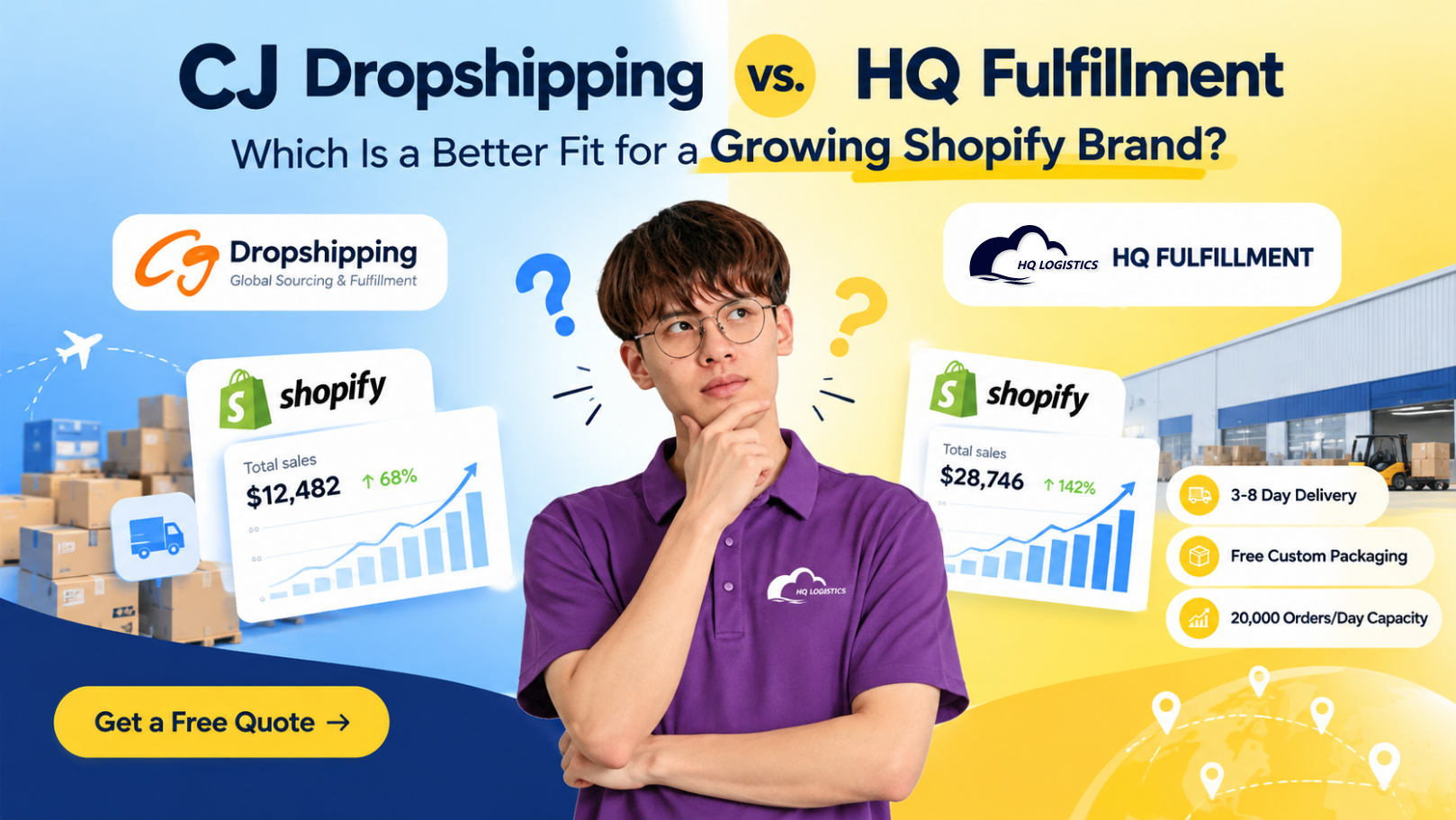
CJ Dropshipping is known for its product sourcing ecosystem, dropshipping workflow, Shopify integration, and global fulfillment options. It can be a practical choice for sellers who want to test products and manage orders through an established platform.
HQ Fulfillment focuses on connecting product sourcing, supplier coordination, quality inspection, warehousing, customization, fulfillment, and shipping in a more integrated supply chain workflow.
Here's a high-level comparison.
| Area | CJ Dropshipping | HQ Fulfillment |
|---|---|---|
| Product sourcing | Product catalog and sourcing requests | Product sourcing and supplier coordination |
| Shopify integration | Supports Shopify order and inventory workflows | Supports Shopify integration and order fulfillment |
| Product testing | Suitable for low-commitment product testing | Supports sourcing and testing based on service requirements |
| Quality control | Product inspection services available | Quality inspection integrated into the fulfillment workflow |
| Custom packaging | Custom packaging options | Custom packaging and branding support |
| Inventory model | Dropshipping and pre-stocked inventory options | China inventory and overseas fulfillment options |
| Warehousing | Global warehouse network | China warehousing and overseas warehouse options |
| Shipping | Multiple shipping options | Multiple shipping channels based on product and destination |
| Supply chain support | Platform-based sourcing and fulfillment | Integrated sourcing, inventory, fulfillment, and shipping support |
| Potential best fit | Sellers prioritizing product discovery and dropshipping workflows | Growing brands seeking more coordinated supply chain support |
Service availability, pricing, eligibility, and specific capabilities can vary by product, destination, and plan. Confirm current details directly with each provider before making a decision.
The key distinction is not that one provider offers fulfillment and the other does not. Both can support ecommerce fulfillment.
The more useful question is:
Which operating model fits your Shopify brand today—and what will you need as it grows?
When launching a Shopify store, you may not know which products will become bestsellers.
You might want to test several product ideas, compare customer responses, and adjust your catalog without committing too much capital to inventory.
At this stage, flexibility matters.
CJ offers product discovery, sourcing requests, Shopify integration, and automated dropshipping workflows. These features can help sellers connect products to their stores and process orders without building a supply chain from scratch.
This model can be useful when your main priority is answering:
Which products attract customer interest?
Which products convert through paid advertising?
Which price points work for my audience?
Which products deserve more investment?
For new stores, an established dropshipping workflow can reduce the amount of manual work involved in product testing.
HQ can support product sourcing and fulfillment for sellers who want to evaluate products while also considering the supply chain needed to scale them.
As a product gains traction, you may want to look beyond the initial sourcing price and evaluate supplier reliability, quality consistency, packaging options, replenishment, and potential warehouse requirements.
This creates a progression from:
Test Products → Identify Winners → Improve Sourcing → Plan Inventory → Scale Fulfillment
The right choice depends on whether you primarily need a convenient product-testing workflow or want to develop a more coordinated sourcing and fulfillment process from the beginning.
Product sourcing becomes more complex as your store grows.
At first, you may mainly care about product availability and price. Later, you may need to consider production capacity, consistent specifications, lead times, customization, and replenishment.
Before choosing a sourcing partner, ask:
Product availability:
Can the provider source the products you need?
Supplier options:
Are there alternatives if your main supplier cannot meet demand?
Cost structure:
Are product prices competitive after considering packaging and other sourcing-related costs?
Production lead time:
Can suppliers meet your replenishment schedule?
Product consistency:
Can specifications be maintained across repeat orders?
Customization:
Can the supplier support changes to the product, labels, or packaging?
CJ's sourcing ecosystem can be useful for finding products through its catalog and sourcing request process. HQ's approach emphasizes coordinating sourcing with other stages of the fulfillment process.
For a growing brand, this connection matters.
Imagine that one of your products starts generating significantly more orders. Finding the same product is only the first step. You also need to know whether the supplier can replenish it on time, maintain quality, and support your next inventory plan.
The goal is not just to find a supplier. It's to build a sourcing process that can support repeat sales.
Quality issues can become more expensive as order volume grows.
A defect affecting a small batch may be manageable. The same issue across a large shipment can lead to refunds, replacements, negative reviews, and additional customer support work.
Both CJ and HQ offer quality-related services, but you should confirm exactly what each service includes.
Are products inspected before entering warehouse inventory?
Are checks performed before individual orders ship?
Can inspection standards be based on written product specifications?
Can defective inventory be identified and separated?
Are photos or inspection records available when required?
Who is responsible if a batch fails the agreed quality requirements?
A robust quality process should connect supplier selection, sample approval, production, inspection, and fulfillment.
For example:
Supplier Selection → Sample Approval → Production → Quality Inspection → Warehouse Receiving → Fulfillment
This process can help identify problems earlier, before they reach customers.
For apparel, checks may include fabric, measurements, stitching, and color consistency. For small electronics, functionality and product specifications may require additional attention. Different product categories need different inspection plans.
Generic packaging may be acceptable when you are testing products. As your business develops, you may want a more recognizable customer experience.
This can include:
Branded Mailers | Custom Boxes | Product Labels | Thank-You Cards | Inserts | Hangtags | Private-Label Packaging
Both CJ and HQ offer custom packaging or branding options. The important consideration is whether the available service matches your requirements, order volume, production schedule, and budget.
Minimum quantities:
Are there minimum order requirements for custom materials?
Production lead time:
Will packaging be ready when inventory is needed?
Design approval:
Can you review samples before production?
Quality consistency:
Will repeat orders match the approved design?
Fulfillment compatibility:
Can the warehouse store and use the packaging efficiently?
For growing brands, packaging works best when it is planned alongside sourcing and fulfillment rather than added at the last minute.
A coordinated process looks like:
Sourcing → Product Approval → Packaging Design → Quality Check → Warehousing → Order Fulfillment
This can help create a more consistent brand experience as your order volume increases.
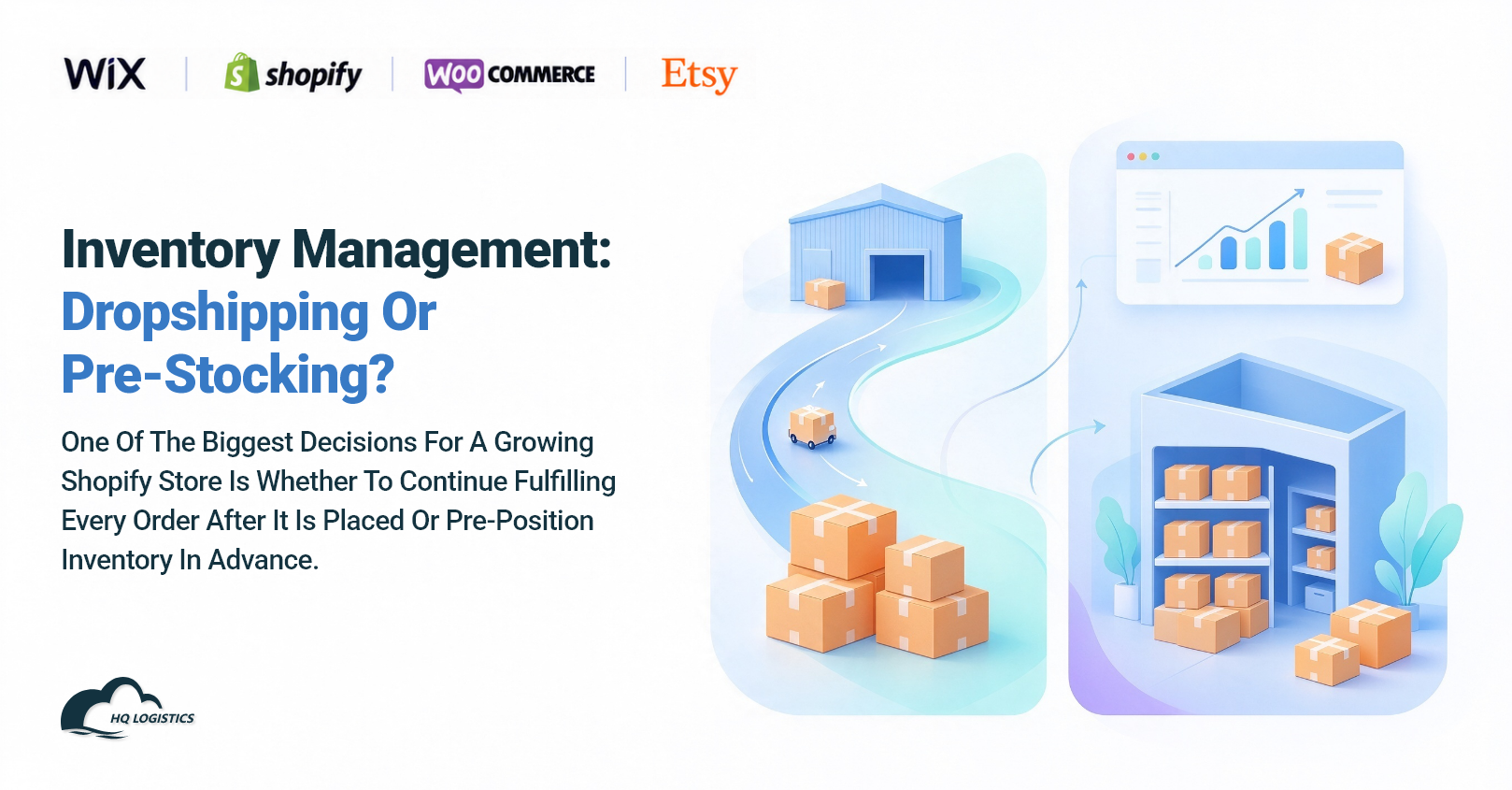
One of the biggest decisions for a growing Shopify store is whether to continue fulfilling every order after it is placed or pre-position inventory in advance.
Neither model is automatically better. The right choice depends on product demand, cash flow, lead times, shipping costs, and inventory risk.
With dropshipping, inventory generally remains with the supplier or fulfillment provider until an order is received.
Potential advantages include lower upfront inventory commitment and flexibility when testing new products.
However, delivery time and availability depend on the selected fulfillment arrangement, product stock, and shipping route.
With pre-stocked fulfillment, you send inventory to a warehouse before customer orders arrive.
This can help you prepare proven products for local fulfillment and reduce reliance on international parcel shipping for every individual order.
However, pre-stocking requires inventory investment and careful forecasting. Unsold products can tie up cash and create storage costs.
For many growing brands, a hybrid approach is worth considering:
New or Uncertain Products → Keep Inventory Flexible
Proven Bestsellers → Consider Pre-Stocking
Stable Regional Demand → Evaluate Overseas Warehousing
CJ offers dropshipping and pre-stocked warehouse options. HQ can also coordinate China-based inventory with overseas fulfillment options for suitable products and markets.
Rather than moving every SKU overseas, focus on the products with predictable demand and calculate whether local fulfillment makes economic sense.
As your customer base expands internationally, inventory location becomes more important.
If a large share of your orders comes from the United States, you may want to compare direct shipping from China with pre-stocking selected products in a U.S. warehouse.
For brands serving multiple European markets, an EU warehouse may also be worth considering.
China Inventory → U.S. Warehouse → U.S. Customer
This model may be useful for proven products with stable U.S. demand and sufficient order volume to justify moving stock in advance.
China Inventory → EU Warehouse → European Customers
An EU warehouse can provide a centralized inventory point for eligible shipments to multiple EU markets. Confirm the warehouse location, supported destinations, local delivery options, and applicable import and tax arrangements before making a decision.
Evaluate:
Customer locations and regional order volume
Inbound transportation costs
Storage and warehouse fees
Local pick-and-pack charges
Domestic or intra-regional shipping costs
Inventory turnover and the risk of unsold stock
Replenishment lead times
Customs, tax, and compliance responsibilities
CJ offers a global warehouse network, while HQ supports China warehousing and overseas fulfillment options. The practical difference for your business depends on the specific warehouse, service, destination, and pricing available.
Choose a warehouse based on your sales data—not simply on how many warehouse locations a provider advertises.
Shipping costs can have a significant effect on profit margins, but the lowest quoted rate does not necessarily produce the best overall result.
The right shipping method depends on product type, weight, dimensions, destination, delivery deadline, and route eligibility.
Before choosing a shipping service, compare:
Shipping Cost | Expected Transit Time | Processing Time | Tracking | Product Restrictions | Customs Arrangements | Final Delivery
For example, a small, urgent shipment may suit an express service, while a larger shipment with more lead time may justify comparing air or ocean freight. Products containing batteries, liquids, powders, magnets, or other restricted materials may need specific routes.
Both CJ and HQ offer multiple shipping options, but route availability and service terms can differ. Request a quote using the same product details, packed dimensions, destination, and delivery requirements to make the comparison meaningful.
Also clarify whether the quoted transit time includes customs clearance and final delivery.
As your store grows, manual order processing can become harder to manage.
A connected workflow can reduce repetitive tasks and improve visibility across orders and shipments.
Before choosing a provider, confirm:
Whether orders sync automatically from Shopify
How inventory information is updated
Whether tracking numbers sync back to Shopify
How order exceptions are handled
Whether SKU mapping supports your product variations
What happens when an item is out of stock
Whether you can monitor fulfillment status through a dashboard or system
CJ provides Shopify integration and automated order workflows. HQ also supports Shopify integration and order and tracking synchronization.
The key is to test the complete process before moving a large number of orders.
Place a test order, check inventory synchronization, confirm that tracking updates correctly, and verify how the system handles cancellations, address changes, and out-of-stock items.
Automation is valuable only when the workflow works reliably from order to delivery.
Peak periods such as Black Friday, Cyber Monday, and Christmas can place extra pressure on suppliers, warehouses, and carriers.
A provider that works well at your current order volume may need additional preparation to handle a sudden increase.
Before peak season, ask your fulfillment partner:
Capacity:
What daily order volume can the operation support under your service plan?
Processing:
What is the normal processing time, and how does it change during peak periods?
Inventory:
Can you pre-stock proven products or replenish them quickly?
Quality:
Can inspection processes scale with larger shipments?
Shipping:
Are alternative routes available if a service experiences delays?
Communication:
How will you be notified about stock shortages, backlogs, or delivery exceptions?
Do not evaluate a provider based only on its advertised maximum capacity. Ask for a realistic plan based on your expected order profile, SKU mix, product type, and destination.
For growing brands, reliable communication and a clear contingency plan can be just as important as headline processing speed.
There is no universal winner. Your current business model and next-stage requirements should guide the decision.
You are testing many products and value a broad product discovery workflow.
You want a platform-based dropshipping process.
You prefer to keep upfront inventory commitments low.
Your current sourcing, shipping, and fulfillment setup meets your needs.
You want to use the provider's existing catalog and sourcing request options.
You want sourcing and fulfillment coordinated through one partner.
You need help comparing or coordinating multiple suppliers.
You want quality inspection integrated with inventory and fulfillment.
You need custom packaging or branding support.
You are considering a hybrid China and overseas warehouse strategy.
You want to review multiple shipping channels for your products and markets.
You need a fulfillment setup tailored to your brand's current order profile.
These are not mutually exclusive business stages, and individual service availability can vary. The best way to decide is to compare actual quotes, product eligibility, operational workflows, and service terms for your own store.
Switching providers is a significant operational decision. Before making a change, review the following:
| Area | Questions to Ask |
|---|---|
| Total cost | What is the complete cost per delivered order? |
| Product sourcing | Can the provider source your existing products? |
| Product quality | Can you approve samples and set inspection standards? |
| Inventory | Can stock levels and replenishment be monitored accurately? |
| Packaging | Can the provider meet your branding requirements? |
| Warehousing | Which locations are available for your target markets? |
| Shipping | Which routes accept your products, and what do they cost? |
| Technology | Can orders and tracking sync with Shopify? |
| Capacity | Can the provider support your expected peak-season volume? |
| Transition | Can you move products gradually and keep orders flowing? |
| Support | Who handles exceptions, delays, and inventory problems? |
You do not have to transfer your entire operation at once.
A phased transition may reduce disruption:
Choose a Few Proven SKUs → Test Samples and QC → Place a Trial Shipment → Test Shopify Integration → Compare Performance → Expand Gradually
Keep existing inventory and order workflows available until the new process has been tested and you are confident it meets your requirements.
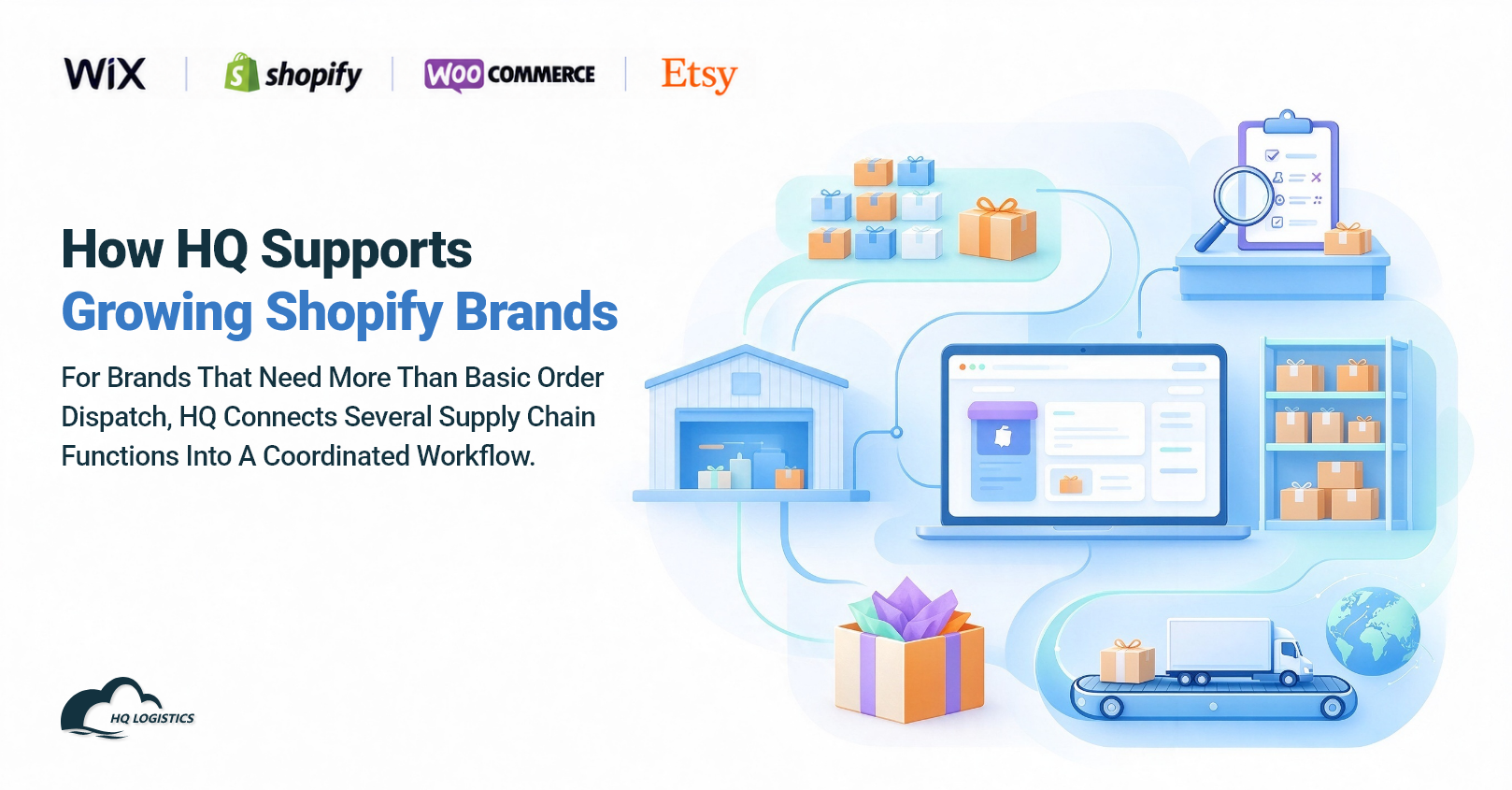
For brands that need more than basic order dispatch, HQ connects several supply chain functions into a coordinated workflow.
Identify product and supplier options based on target price, specifications, and quality requirements.
Check products against agreed specifications before they enter fulfillment or are shipped.
Coordinate suitable labels, inserts, and branded packaging to support a more consistent customer experience.
Keep new or lower-volume products flexible while testing demand and planning replenishment.
Evaluate overseas inventory positioning for proven products with stable demand in the relevant markets.
Connect order workflows and synchronize tracking information to reduce manual processing.
Compare available shipping options based on product characteristics, destination, delivery needs, and total cost.
HQ also offers two months of free U.S. warehouse storage for eligible products and plans, subject to applicable requirements. Confirm eligibility, storage terms, and other service charges with HQ before sending inventory.
The goal is not to force every brand into one fulfillment model. It is to help connect sourcing, quality, inventory, warehousing, and shipping in a way that fits the business.
Choosing between CJ Dropshipping and HQ Fulfillment is not simply a question of which provider has more features.
It is about finding the operating model that fits your brand's current needs and future plans.
CJ may be a practical choice if your priority is product discovery, dropshipping, and an established platform workflow.
HQ may be worth comparing if your brand needs more coordinated sourcing, quality inspection, custom packaging, inventory planning, warehousing, and shipping support.
Before making a decision, compare the complete cost per delivered order, confirm the services available for your products and destinations, and test the operational workflow.
Choose the model that fits your business. Build the supply chain that supports your growth.

CJ provides product sourcing, Shopify integration, order fulfillment, warehousing, and shipping options, making it a practical option for many dropshipping businesses. Whether it is the best fit depends on your products, costs, service requirements, and growth plans.
Yes. Shopify sellers can compare HQ with CJ based on sourcing, quality control, custom packaging, warehousing, shipping options, inventory management, and the level of supply chain support they need.
There is no universal answer. Compare actual pricing, service terms, product eligibility, fulfillment workflows, and support for your expected order volume. The best fit is the provider that meets your requirements at an acceptable total cost.
If your current setup has recurring issues, review alternatives before the peak period rather than during it. Allow enough time for sample checks, test shipments, Shopify integration testing, inventory transfers, and a gradual transition.
Pre-stocking may be worth considering for proven products with stable regional demand. Compare inbound transportation, storage, local fulfillment, delivery costs, inventory turnover, and the risk of unsold stock before committing.
HQ offers custom packaging and quality inspection support, subject to product and service requirements. Confirm available options, inspection scope, minimum quantities, and lead times before placing an order.
Compare the total cost per delivered order, including product cost, packaging, processing, storage, transportation, customs-related costs where applicable, returns, and any additional service fees. Also evaluate inventory visibility, quality, communication, and scalability.
📩Email: zoye@fulfllment-cn.com
PREVIOUS RECOMMENDATIONS


CJ Dropshipping vs. HQ Fulfillment,CJ Dropshipping alternative, HQ Fulfillment, Shopify fulfillment partner, CJ Dropshipping for Shopify, ecommerce fulfillment, dropshipping supplier, Shopify supply chain, product sourcing, quality inspection, custom packaging, China fulfillment, U.S. warehouse, EU fulfillment, overseas warehousing, global shipping, inventory management, Compare CJ Dropshipping vs. HQ Fulfillment for a growing Shopify brand. Explore product sourcing, quality control, custom packaging, warehousing, shipping, and supply chain support to find the right fit for your business.



Customer's favorable comments is our eternal motivation. We feel grateful for all the support and company.

Lorem ipsum dolor sit amet, consetetur sadipscing elitr, sed diam nonumy eirmod tempor invidunt ut labore et dolore magna aliquyam erat, sed diam voluptua.